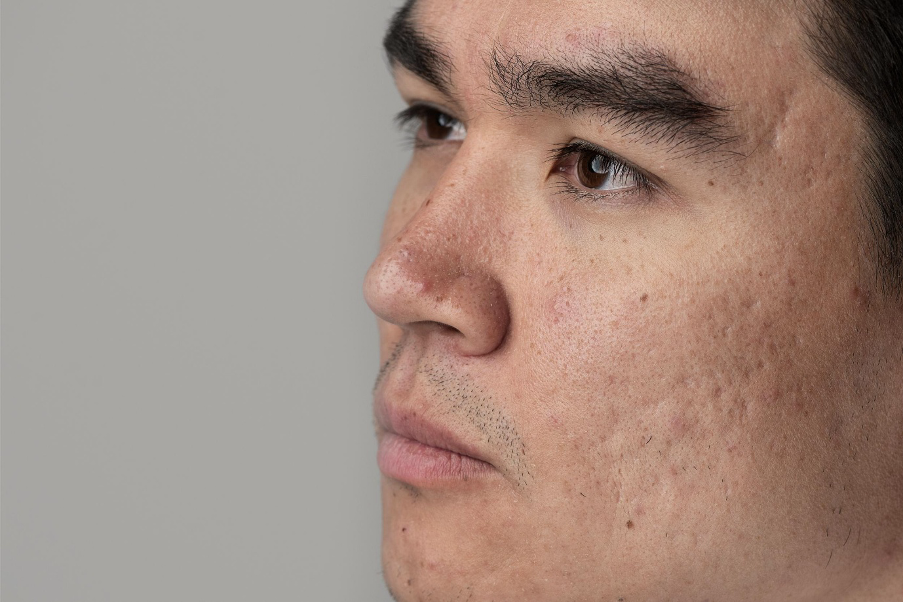
A different conversation
Many men are curious about aesthetic medicine but do not know what it includes, what to ask for, or whether it is really meant for them.
The simplest explanation is this:
Aesthetic medicine is medical care for concerns about the skin, hair and appearance.
It may involve skincare, treatment of sun damage or acne scarring, support for thinning hair, or carefully planned procedures for changes in the face. It does not have to mean looking younger, changing the way you look or trying to fit somebody else’s idea of attractiveness.
Some men want to look less tired. Some want healthier skin, fewer shaving problems or help with acne scars. Some have noticed hair thinning or changes around the eyes and jawline. Others simply want to understand what is happening and whether anything can sensibly be done.
A consultation is a place to work that out. Treatment is optional.
What is aesthetic medicine?
Imagine a house that changes slowly with time.
The paint may become uneven. The surface may develop marks. The supporting materials underneath may change shape, and familiar lines may become deeper. Looking after the house does not mean rebuilding it or making it look like every other house. It means understanding what has changed and deciding whether any careful maintenance would be useful.
The face is far more complex than a house, but the same idea helps.
Aesthetic medicine considers:
- The health and quality of the skin
- Pigmentation, redness and sun damage
- Acne and acne scarring
- Facial movement and expression lines
- Changes in facial support and volume
- The eye area
- Jawline and neck changes
- Hair loss and thinning
- How all of these features fit together
Some concerns can be managed with simple daily care. Some may benefit from a medical prescription or a procedure. Some are better left alone.
The aim at Atelier is not to find a treatment for every feature. It is to help each patient understand the options and make a decision that feels appropriate for them.
Is aesthetic medicine only for women?
No.
Skin ages, heals, scars and responds to sunlight in everyone. Men can develop acne, rosacea, pigmentation, skin cancer, hair loss and changes in facial structure. Wanting advice about these concerns is no different from seeking medical advice about another part of the body.
However, many aesthetic clinics and advertisements have historically spoken mainly to women. A man entering this space may feel that he is expected to know unfamiliar language, choose a treatment from a menu, or explain his concern using words that do not feel natural to him.
He does not need to.
It is enough to say:
- “I always look tired.”
- “My skin has become rough and uneven.”
- “These acne scars bother me.”
- “I am noticing more sun spots.”
- “My hair is becoming thinner.”
- “I do not want to look different, but I would like to understand my options.”
The doctor’s role is to translate the concern into an anatomical and medical assessment, then explain what may or may not help.
Are men’s faces and skin different?
Caption: Every face is individual. Treatment planning begins with the patient’s own anatomy, movement, skin and preferences.
There are some average biological differences between male and female skin and facial anatomy, but averages are not rules.
Men commonly have:
- Greater facial muscle mass
- Different skull proportions and fat distribution
- A more prominent brow, chin or jaw in some individuals
- Higher sebum, or skin-oil, production
- More facial hair and regular shaving-related irritation
- Differences in skin thickness, collagen and the pattern of facial ageing
These features vary with genetics, ethnicity, hormones, age, weight, health and the individual. Not every man has thick or oily skin. Not every man has a broad jaw, heavy brow or dense beard. Gender identity also does not tell a doctor what facial result a patient wants.
This matters because aesthetic treatment should never be copied from a standard diagram or a “male formula.” A plan that suits one face may look unnatural on another.
The starting point is always the person in the room.
Why might a man consider aesthetic care?
There is no correct age to begin and no feature that requires treatment. These are simply some of the reasons men ask for advice.
“I look tired, even when I am not”
The eye area may look tired because of several different things:
- Pigmentation
- Visible blood vessels or redness
- A natural hollow beneath the eye
- Changes in cheek support
- Fine lines or skin laxity
- Eyelid heaviness
- Poor sleep, allergy or a medical condition
These causes are not interchangeable. A treatment that changes skin quality will not correct every structural hollow, and changing facial volume will not treat an allergy or sleep problem.
Assessment begins by identifying the cause. Options may include skincare, laser or energy-based treatment, support for skin quality, treatment of facial structure, medical review, or no treatment.
Relevant website link: Eye Rejuvenation
“My skin looks rough, dull or older than I feel”
Sun exposure, shaving, acne, oil production, dryness and a simple lack of skincare can all affect the surface of the skin.
For many men, the useful first step is not a complicated ten-product routine. It may be:
- A suitable cleanser
- A moisturiser if needed
- Broad-spectrum SPF 50+ sunscreen
- One carefully chosen active product
Medical skincare, hydration-focused care, microneedling, laser resurfacing or other skin treatments may be considered depending on the diagnosis and the amount of downtime the patient accepts.
Relevant website links: Hydration & Skin Quality, Medical Skincare, 3D Miracle Laser, Laser Resurfacing, RF Microneedling
“I have sun damage, redness or brown marks”
Uneven colour may come from freckles, solar lentigines, melasma, post-inflammatory pigmentation, visible blood vessels or chronic redness. A rough or changing mark may be a medical skin lesion rather than a cosmetic concern.
Diagnosis comes before treatment. A new, changing, bleeding, crusting or persistently scaly spot should be appropriately assessed before any cosmetic procedure is considered.
Depending on the cause, management may include daily sun protection, topical care, light or laser-based treatment, or referral for a dedicated skin cancer assessment.
Relevant website link: Pigmentation & Redness
“I still have acne or acne scars”
Acne does not always end in adolescence. Oil production, hormones, occlusive products, shaving and individual skin biology may all contribute.
Active acne and acne scarring are different problems:
- Active acne includes blocked pores, inflamed pimples, pustules or deeper nodules.
- Post-inflammatory marks are flat red or brown areas left after inflammation.
- Acne scars are permanent changes in skin texture, such as dips, narrow pits or raised scars.
The first priority is controlling active acne and preventing new scars. Existing scars may then be assessed according to their shape and depth. Different scars may require different methods, including resurfacing, microneedling, subcision or a combined plan.
No procedure removes every scar, and stronger treatment is not always better. Skin tone, inflammation and the risk of pigmentation need to be considered.
Relevant website link: Acne & Scarring
“My expression lines are becoming deeper”
Facial muscles pull on the skin every time a person frowns, squints, smiles or raises the eyebrows. Over time, a line that first appeared only during movement may remain visible at rest.
Men often have strong facial muscles, but muscle strength and movement patterns vary considerably. The goal is not automatically to remove all movement. Some patients want a small change while preserving normal expression. Others decide that their lines are part of their face and do not want treatment.
Where treatment is considered, the consultation should include how the face moves, the position of the brows and eyelids, the patient’s work and preferences, possible adverse effects, alternatives and what a realistic change might look like.
Relevant website link: Softening Expression Lines
“My face has changed shape”
The face changes at several levels as it ages. Bone remodels, fat compartments shift or reduce, ligaments and skin change, and repeated muscle movement affects the surface.
Weight change, dental changes, illness and genetics may also alter facial shape.
This can appear as:
- Flatter or more hollow cheeks
- Temple hollowing
- Deeper folds
- Changes beneath the eyes
- Reduced definition through the lower face
- Looser skin around the jawline or neck
Some patients may benefit from treatment that supports skin quality or facial structure. Others may be better suited to a surgical opinion, a dental assessment, weight stability or no treatment.
For men who do want treatment, the plan should respect the proportions of their own face. Creating an exaggerated jaw or copying a celebrity’s profile is not individualised medical care.
Relevant website links: Facial Support & Volume, Skin Firmness & Regeneration, Jawline & Neck Definition, Ultra Restore Laser
“My hair is thinning”
Male pattern hair loss is common and is influenced by genes and hormones. Hair follicles gradually become smaller, producing finer and shorter hairs. It often begins at the temples, hairline or crown.
Other conditions can also cause shedding or hair loss, including alopecia areata, inflammation, infection, medication effects, nutritional deficiency, thyroid disease and physical or psychological stress.
Early assessment is useful because treatment generally aims to preserve and support existing follicles. It cannot always restore follicles that have stopped producing hair.
Management may include investigation, topical or prescription options, procedural support, camouflage or referral for hair transplantation. Prescription treatment requires discussion of possible benefits, risks, contraindications and the need for ongoing use.
Relevant website link: Hair Loss & Thinning
What happens at the consultation?
Dr Hollie will usually ask:
- What has the patient noticed?
- How long has it been present?
- Does it affect confidence, comfort or daily life?
- Is the patient hoping for a small change, a more visible change, or information only?
- What would the patient not want to change?
- How much maintenance or downtime would be acceptable?
- What medical conditions, medicines, allergies or previous treatments are relevant?
Assessment may include the skin, facial structure, movement, proportions, hair or the specific area of concern. Clinical photographs may be recommended for medical documentation. Ultrasound may be used where clinically appropriate and where seeing beneath the skin may add useful information.
The options are then explained in plain language:
- What the treatment is intended to do
- What it cannot do
- The likely time course
- Possible risks and adverse effects
- Downtime and aftercare
- Alternatives, including doing nothing
- Whether maintenance may be needed
The patient can ask questions, take time to think and decide later. A consultation does not create an obligation to proceed.
Will treatment look obvious?
No clinician can guarantee that a treatment will be invisible or that every result will appear natural. Results vary, and even a carefully performed procedure can produce swelling, bruising, asymmetry, an unwanted result or a complication.
However, a conservative plan can be designed around preserving recognisable expression and proportion.
Useful questions include:
- What is the smallest change that may address the concern?
- Which features should be preserved?
- Will treating one area affect another part of the face?
- Is the expected benefit worth the risk, cost and maintenance?
- Would staged treatment provide more control?
- Would no treatment be the better choice?
Atelier is not interested in creating a standard “treated” male face. The aim is to make careful decisions with the patient, based on their own priorities.
Does looking after your appearance make you vain?
No. It also does not make treatment necessary.
Appearance is one part of how people experience themselves and how they move through work, relationships and daily life. A man may care about his skin or hair for the same reason he cares about dental health, clothing, fitness or grooming.
The important question is not whether he is allowed to care. It is whether the decision is informed, proportionate and genuinely his.
Aesthetic treatment should not be used to:
- Meet somebody else’s demand
- Repair a relationship
- Fix every insecurity
- Chase an edited or filtered image
- Respond impulsively to a trend
- Create perfection
If expectations are unrealistic, distress seems out of proportion to the physical feature, or treatment is unlikely to help, postponing or declining treatment may be the most appropriate medical decision.
What makes a good result?
A good result is not simply “more” or “less.”
It may mean:
- Skin that feels healthier and is easier to manage
- A scar that is softer but still visible
- Pigment or redness that is less noticeable
- A face that looks better rested without looking unfamiliar
- Movement that remains expressive
- A treatment plan that fits the patient’s tolerance for downtime and maintenance
- Understanding the options and choosing not to proceed
Success should be defined before treatment. If the patient and doctor are aiming at different outcomes, even technically competent treatment may feel wrong.
A simple starting point
If all of this still feels unfamiliar, begin with three questions:
- What bothers me?
- What do I want to keep the same?
- How much treatment, risk, downtime and maintenance am I comfortable with?
The answer does not need to sound medical.
“I look tired.”
“I want my skin to look healthier.”
“I want advice about my acne scars.”
“I am worried about my hair.”
“I am curious, but I do not want to look different.”
That is enough to begin the conversation.
The Atelier approach
Atelier provides doctor-delivered aesthetic medical care in a calm and unhurried setting.
Recommendations are based on the patient’s health, anatomy, skin, treatment history and goals. Education comes before treatment. Sometimes the plan is simple skincare. Sometimes it is a staged procedure. Sometimes it is waiting, seeking another medical opinion or choosing no treatment.
We are not interested in treating more. We are interested in treating better.
The aim is for every patient to leave feeling respected and more confident in the decision they have made, whether that decision is to have treatment, delay it or not have it at all.
Curious, but not sure where to start?
A consultation is simply a place to ask questions, discuss a concern and understand the options. Patients do not need to know which treatment they want, and there is no obligation to proceed.
References
- Rahrovan S, Fanian F, Mehryan P, Humbert P, Firooz A. Male versus female skin: what dermatologists and cosmeticians should know. International Journal of Women’s Dermatology. 2018;4(3):122–130. https://pmc.ncbi.nlm.nih.gov/articles/PMC6116811/
- Keaney TC. Aging in the male face: intrinsic and extrinsic factors. Dermatologic Surgery. 2016;42(7):797–803.
- Swift A, Liew S, Weinkle S, Garcia JK, Silberberg MB. The facial aging process from the “inside out.” Aesthetic Surgery Journal. 2021;41(10):1107–1119. https://pmc.ncbi.nlm.nih.gov/articles/PMC8438644/
- Keaney TC. “Man-some”: a review of male facial aging and beauty. Journal of Drugs in Dermatology. 2017;16(6 Suppl 2)–s93. https://jddonline.com/articles/man-some-a-review-of-male-facial-aging-and-beauty-S1545961617S0091X/
- Australian Prescriber. Male and female pattern hair loss. 2025. https://australianprescriber.tg.org.au/articles/male-and-female-pattern-hair-loss.html
- Royal Australian College of General Practitioners. Male baldness. Australian Family Physician. 2016;45(4). https://www.racgp.org.au/afp/2016/april/male-baldness
- Australian Health Practitioner Regulation Agency. Advertising higher risk non-surgical cosmetic procedures. https://www.ahpra.gov.au/Resources/Cosmetic-surgery-hub/Cosmetic-procedure-advertising-guidelines
Medical disclaimer
This information is provided for general educational purposes only. It does not constitute personal medical advice and should not replace an individual, in-person consultation with an appropriately qualified healthcare practitioner. Treatment suitability, expected outcomes and potential risks vary between patients and require assessment of your medical history, clinical findings and individual circumstances.
